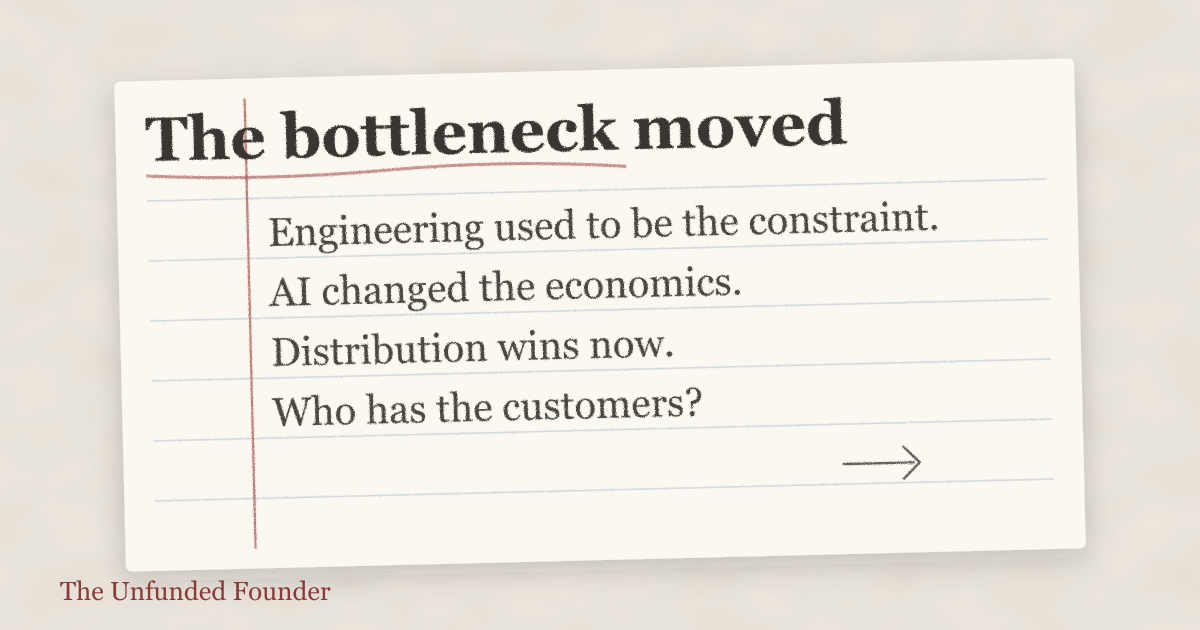
For most of the SaaS era, engineering capacity was the bottleneck. Product roadmaps, team structures, and company planning all evolved around that constraint. Job descriptions were written to ensure that every hour and every pound on tech time and development was spent effectively. Every day spent building the wrong thing was a day all your competitors got ahead. The engineering team was the most expensive part of the business.
Non-technical founders ended up adapting themselves to the operating model of the engineering team rather than the other way around (although huge credit must be given to the software development industry for things like the Agile manifesto - many progressive ideas from software devs have gone mainstream).
AI-assisted development changes the economics. The bottleneck in business now surely sits elsewhere, in particular, distribution. Small, highly opinionated teams have a big advantage over corporate monoliths. The people with access to customers are the biggest winners of all. Software companies sitting on ancient legacy software, nevertheless deeply embedded with their customers, have a once-in-a-generation opportunity to rebuild better, cheaply, and expand.